Trusted by 100,000+ Families

What is Developmental Dyscalculia?

Home>>Neurodiversopedia>>D Terms

Summary

summary

Developmental dyscalculia is a learning difference that affects a person’s ability to understand and work with numbers. It can make learning and using math concepts and skills challenging for individuals. People with dyscalculia may have difficulty counting, recognizing patterns, understanding math symbols, and solving mathematical problems.

Frequently Asked Question

donut

Can Developmental Dyscalculia be outgrown?

Developmental Dyscalculia is a lifelong condition, but with appropriate interventions and support, individuals can improve their math skills and manage the challenges associated with dyscalculia.

How is Developmental Dyscalculia diagnosed?

Diagnosis typically involves comprehensive assessments that evaluate math abilities, cognitive functioning, and ruling out other potential factors impacting math performance.

Can individuals with Developmental Dyscalculia excel in other areas despite their math difficulties?

Absolutely! Developmental Dyscalculia specifically affects math skills, but individuals with dyscalculia can excel in other areas such as language, arts, sciences, and social skills.

Are there any specific accommodations that can be provided to students with Dyscalculia?

Accommodations may include extra time for math assignments and tests, the use of calculators or math aids, providing visual supports, and breaking down complex math problems into smaller, manageable steps.

Scientific Definition

scientist

Developmental dyscalculia, or math dyslexia, is a neurodevelopmental disorder characterized by difficulties acquiring and understanding mathematical concepts and skills. It is a specific learning disorder that affects individuals despite having adequate intelligence and educational opportunities. People with dyscalculia may struggle with number sense, arithmetic operations, mathematical reasoning, and spatial organization of quantities. This condition is distinct from general intellectual disabilities and other learning disabilities, such as dyslexia or attention deficit hyperactivity disorder (ADHD). Early identification and appropriate interventions can help individuals with dyscalculia overcome challenges and develop strategies to succeed in math-related activities.

Treatment for Developmental Dyscalculia

While there is no cure for developmental dyscalculia, various strategies, and interventions can help individuals manage and overcome its challenges. Here are some that you can try:

  • Multisensory Learning: Engage multiple senses, such as touch, sight, and hearing, to reinforce math concepts.
  • Visual Aids: Utilize visual representations, manipulatives, and charts to enhance understanding of numbers and operations.
  • Structured Practice: Provide consistent and structured practice opportunities to reinforce math skills and build confidence.
  • Individualized Instruction: Tailor teaching methods to the child’s specific needs, pace, and learning style.
  • Technology Tools: Incorporate educational apps and tools, like Goally, that offer interactive math activities and personalized learning experiences.

With appropriate interventions and support, individuals with developmental dyscalculia can develop coping strategies, improve their math skills, and succeed in academic and everyday math-related tasks. Ongoing support and accommodations can help individuals thrive and reach their full potential.


Symptoms of Developmental Dyscalculia

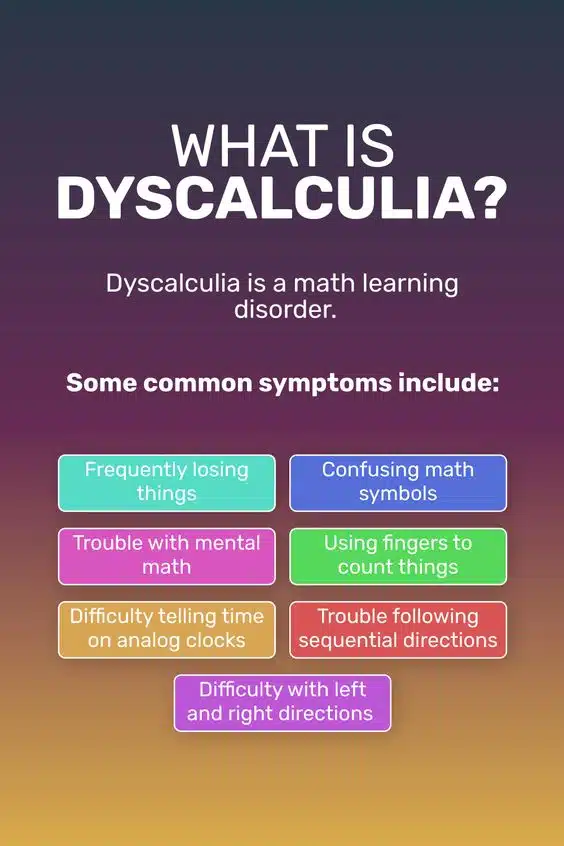
Developmental dyscalculia can manifest in various ways. Here are some of the most common symptoms that you should watch out for:

  • Difficulty understanding and recognizing numbers and number patterns.
  • Struggles with basic arithmetic operations, such as addition, subtraction, multiplication, and division.
  • Challenges with memorizing math facts and recalling them quickly.
  • Poor sense of quantity and difficulty estimating or comparing numbers.
  • Inability to grasp mathematical concepts and apply them in real-world situations.
  • Trouble understanding and interpreting graphs, charts, and mathematical symbols.
  • Difficulty organizing and sequencing steps in math problem-solving.

Recognizing the symptoms of Developmental Dyscalculia allows for early intervention and support. Goally, a versatile tablet, offers engaging apps that enhance math skills and problem-solving abilities for children with dyscalculia. It also provides executive functioning and life skills apps for organization, self-regulation, and social interactions.


Editor’s note: This information is not meant to diagnose or treat and should not take the place of personal consultation, as needed, with a qualified healthcare provider and/or BCBA.